How to get an internship in college: Real advice from real students
Getting an internship starts with a few key steps: building your resume, searching early, networking, and applying consistently.
The process can feel overwhelming, but hearing how real students made it happen will help you get started!

The good news? Most students who land internships didn't start with perfect resumes or professional connections. They started by showing up, asking questions, building relationships, and applying anyway.
We spoke with Steve Rottinghaus, career and outreach coordinator for the William Allen White School of Journalism and Mass Communications, along with several KU students who shared what helped them successfully navigate the internship search process.
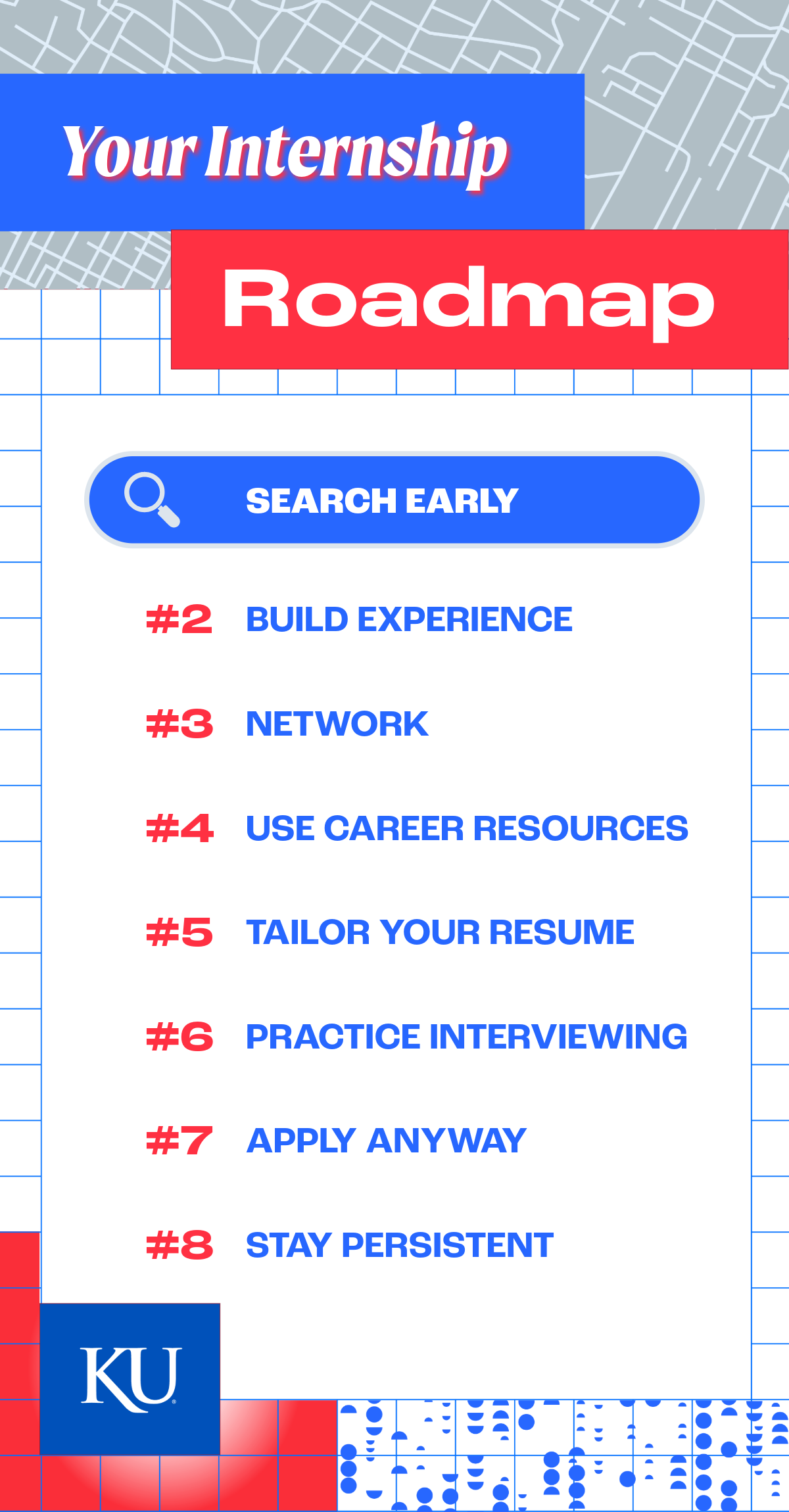
How to get an internship: step by step
What we heard again and again from students and career experts was that landing an internship isn't usually about one big breakthrough. It's often a series of small steps that build on each other.
- Start looking earlier than you think.
- Build a resume using coursework, projects, and campus involvement.
- Attend career fairs and networking events.
- Use LinkedIn, Handshake, and your school's career center.
- Customize your resume for every application.
- Prepare for interviews before opportunities arise.
- Apply even if you don't meet every qualification.
- Stay persistent.
Most students find internships through career fairs, LinkedIn, Handshake, professors, alumni connections, and company websites.

How to get an internship with no experience
One of the biggest misconceptions students have is that they need previous internship experience to land their first internship.
According to Rottinghaus, employers are often looking for much more than a polished resume.
"Strong communication skills help students stand out. Students' ability to verbally express their career interests and explain how their experiences collaborating with classmates on classroom projects resonate with employers is invaluable."
Will Benjes, a KU engineering student who has navigated the internship search process several times, encourages students to rethink what counts as experience.
"Experience on a resume or interview doesn't need to be from a previous internship. Especially if you don't have much of it, class projects can be excellent experience that is used to show leadership qualities or experience in your field."
If you're building your first resume, consider including:
- Class projects
- Student organizations
- Volunteer work
- Research experiences
- Campus jobs
- Leadership positions
- Certifications
- Relevant coursework
Clubs can demonstrate leadership, event planning, marketing, and project management. Volunteer work can showcase teamwork and communication skills, while coursework and projects can highlight technical knowledge and subject matter expertise.

Where to find internships (and when)
If there's one piece of advice that came up repeatedly, it's this: don't wait until junior year to start thinking about internships.
"I like to see students start thinking about internships during the second semester or at the start of their sophomore year," Rottinghaus says. "I want them to explore opportunities on campus that put them in better position to land an internship."
Many students focus on applications but spend less time thinking about where internship opportunities actually come from.
The reality is that successful students often use several strategies at once.
1) Career fairs
Career fairs are one of the best ways to meet recruiters, learn about opportunities, and practice talking about your interests and goals.
Sriya Annem, a recent KU computer science graduate who turned a career fair conversation into a professional relationship that eventually led to a job offer, remembers feeling intimidated.
"The KU Career Fair was one of the first intimidating moments of my college experience. I was a freshman with very little technical experience, but I still walked up to the Netsmart booth because something in me wanted to try."
She didn't leave with an internship offer, but she did leave with a roadmap.
"They didn't offer me a role. I wasn't qualified yet, but they did offer me something better: genuine advice. They told me what classes to take, what skills to build, and what they looked for in future interns. I remember walking out of that arena thinking, 'OK. I can work toward this.'"
She kept showing up. "I kept going to career fairs. I kept saying hi. And the next year, Netsmart remembered me."
That relationship became the foundation for future opportunities.

2) LinkedIn and networking
Networking doesn't always happen at formal events.
Annalia Escalante, a KU Public Administration student who credits networking with helping her discover internship opportunities, says some of the best opportunities come from everyday conversations.
"Networking is not always done through fancy networking mixers or events. Sometimes, it is in the conversations you have on a daily basis."
One conversation ended up opening an unexpected door.
"I went on a trip and met someone who was able to share an opportunity about an internship I would eventually land. Even though it was my first time meeting or talking with them, I made an effort to know about them and their career, and they did the same. That opportunity that they shared with me opened the door to so many more after. "
She also recommends reaching out directly to professionals. "A great way to meet people in your field is by simply messaging someone for a coffee-chat via LinkedIn or email."
Rottinghaus agrees.
"Networking is extremely important. When advising students, I always encourage them to think of all the connections they have developed through school, previous work experiences and through their family's contacts."

3) Professors and mentors
Faculty members often have industry connections and can help students identify opportunities that may never appear on a job board.
Drake Schotland, a recent graduate of the School of Business, encourages students to build those relationships early.
"Develop relationships with your professors. Professors have connections in the field you're studying and want to help you succeed."
4) Handshake, job boards and company websites
Internship platforms remain one of the easiest ways to find opportunities across industries.
Schotland recommends creating strong profiles and keeping them updated.
"Handshake lists thousands of internships and full-time roles that you can filter to your liking, and oftentimes recruiters will reach out to you first on the platform."
Many employers post internship opportunities directly on their careers pages before they appear elsewhere. If there's a company you're interested in, make a habit of checking its website regularly and signing up for job alerts when available.

5) Use campus resources to your advantage
Many students don't realize they already have access to people whose job is helping them prepare for internships.
The University Career Center can help you strengthen your resume, practice interviewing, improve your LinkedIn profile, and identify opportunities that fit your goals.
Many academic divisions have their own career services, too. No matter where you go for support, Schotland recommends taking advantage of those resources early.
"Create profiles and fine-tune them on LinkedIn and Handshake. KU's Business Career Services can help you build these profiles to exactly what employers are looking for."
He also encourages students to get feedback on their application materials. "Business Career Services will help you build a professional resume you can confidently hand to employers."
Escalante recommends using the career center for more than just resume reviews. "Use the career center to help you write a cover letter. You should have a different cover letter for different roles, so don't forget to customize!"
She also suggests practicing before the real thing. "Practice interviewing with friends or people you are comfortable with, then try a mock interview with the career center."
Rottinghaus sees these resources as a way for students to gain confidence before applying. "I assist students in their search for jobs and internships through reviews of resumes, cover letters and portfolios, and mock interviews."
The earlier you seek feedback, the more prepared you'll be when opportunities arise.

6) Customize your resume for every internship
A common mistake students make is submitting the same resume for every application.
Rottinghaus says employers notice immediately. "Employers notice immediately when a student's resume was not designed specific to the job description."
Escalante recommends focusing on impact. "Try to quantify where possible and show impact through numbers. It helps anyone reading your resume picture your impact and the gravity of it."
Many of the students we spoke with noted that it was important to include experiences from clubs, volunteer work, coursework, and projects when relevant.
Another easy way to strengthen your professional presence is keeping your online profiles current.
Rottinghaus recommends updating your LinkedIn profile every semester. "Prospective employers want to see fresh content."
7) Prepare for interviews before you need one
The best interviews often start long before an interview invitation arrives. Escalante recommends preparing stories that demonstrate your skills and accomplishments.
"Make sure to be prepared for an interview by practicing the STAR (Situation, Task, Action, Results) Method to communicate your impact and skills to the fullest potential."
She also recommends asking questions and researching organizations thoroughly.
"Research the organization and role and find where you align. Be able to show a genuine interest in them beyond the role. And remember, you are interviewing them too!"
When interviewers ask whether you have questions, don't miss the opportunity. Benjes emphasizes the importance of showcasing your curiosity.
"Always have several insightful and genuine questions for your interviewer for when they ask you if you have questions."
One of his favorite suggestions: "What does an average day for an intern look like here?"
Schotland recommends another strong option: "What are some traits you've noticed that successful people in this role have had in the past?"
Good questions demonstrate curiosity, preparation, and genuine interest.
Apply anyway
One of the biggest reasons students miss opportunities is because they assume they aren't qualified enough.
Rottinghaus offers simple advice: "Go ahead and apply. The more repetition you get applying for positions benefits students in the long run."
Annem shares a similar perspective. "You don't need to feel ready to start. You just need to start."
She encourages students to take chances even when they're uncertain. "Go to the career fair, even if you feel inexperienced. Talk to recruiters, even if you think you won't get an interview."
Her professional career journey began with a simple LinkedIn message. "My full-time role came from a cold LinkedIn message I sent during my lunch break."
She stayed in touch, continued building the relationship, and eventually turned that connection into a job offer.

Once you get an internship, make it count
Landing the internship is only the beginning.
Rottinghaus encourages students to take ownership of projects before their internship ends. "Before an internship is over, students should take the initiative and ask to take a lead on a project."
The goal is to leave with accomplishments you can discuss in future interviews. "I always encourage students to take ownership of a project, so they can say, 'I did that,' and highlight that on their resume."
Every internship becomes preparation for the next opportunity.
The bottom line
There is no secret formula for getting an internship.
The students who succeed are usually the ones who start before they feel ready, build relationships, seek feedback, and keep trying.
As Annem puts it:
"Most opportunities don't come from 'perfect timing.' They come from staying curious, showing up, and keeping doors open."
Sometimes the first step is simply deciding to start.
Internship FAQ
Getting an internship can be competitive, but many students find success through networking, career fairs, campus resources, and persistence. Building relationships and applying consistently can improve your chances.
Many employers recruit months in advance. Career advisors often recommend exploring internships as early as your sophomore year and attending career fairs from your first year onward.
Use class projects, volunteer work, student organizations, research experiences, certifications, and campus involvement to demonstrate your skills. Employers often value potential and willingness to learn as much as previous experience.
There is no perfect number. Apply broadly, focus on opportunities that align with your interests, and customize your materials for each role.
According to University of Kansas students, yes. Career fairs help students meet recruiters, learn what employers are looking for, practice professional conversations, and build relationships that can lead to internships and future job opportunities.