Double majoring at KU: What it means and how four Jayhawks made it work
What if you're interested in two subjects and don't want to choose just one?

At the University of Kansas, many Jayhawks pursue a double major, combining academic interests, building complementary skills and preparing for a variety of career paths. Some pair programs from different schools and academic units, while others combine two majors within the same college.
For four Jayhawks, those combinations look different. One connects biology and exercise science to understand human performance. Another pairs German and finance. A third combines computer science and data science, while a fourth brings together communication studies and political science in preparation for law school.
What is a double major?
A double major means completing the requirements for two academic majors during your undergraduate education. Depending on the programs involved, students may earn two majors within a single bachelor's degree or, in some cases, pursue two separate bachelor's degrees.
Why do students choose to double major?
Some students combine fields that support a specific career path. Others pair a personal passion with professional preparation or discover a second academic interest after arriving on campus.
The four students below each took a different approach, showing how academic interests can connect at KU.
Emily Ahern connects biology with exercise science

Emily Ahern arrived at KU planning to study molecular, cellular and developmental biology (MCDB) in the College of Liberal Arts & Sciences. After getting involved in campus research, she discovered another interest: exercise science.
As someone who hopes to become an orthopedic surgeon, Ahern saw a connection between understanding how the body works and studying how people move and perform.
"Honestly, with how rigorous a biology degree can be, despite how much I love those classes, I really wanted to pursue another degree that would well round me and give me more practical experience, so I chose to add exercise science," she said.
The two fields complement each other: biology provides a foundation for understanding the body's systems, while exercise science applies that knowledge to movement and physical performance. Through research in the exercise science department, Ahern applies anatomical, physiological and biomechanical concepts to sports performance. Her work has also given her opportunities to speak at conferences and connect with professionals and KU faculty.
Balancing both majors takes planning. Ahern divides her credit hours between the two areas, with help from her academic advisor in finding courses that fulfill requirements across her degree plans.
"I thought double majoring would be extremely difficult to balance, but the support I have received to plan my semesters in ways that I am able to be successful in, as well as the in-class support that's available has made the whole process so much less stressful," she said.
Nathanael Getahun combines computer science with data science
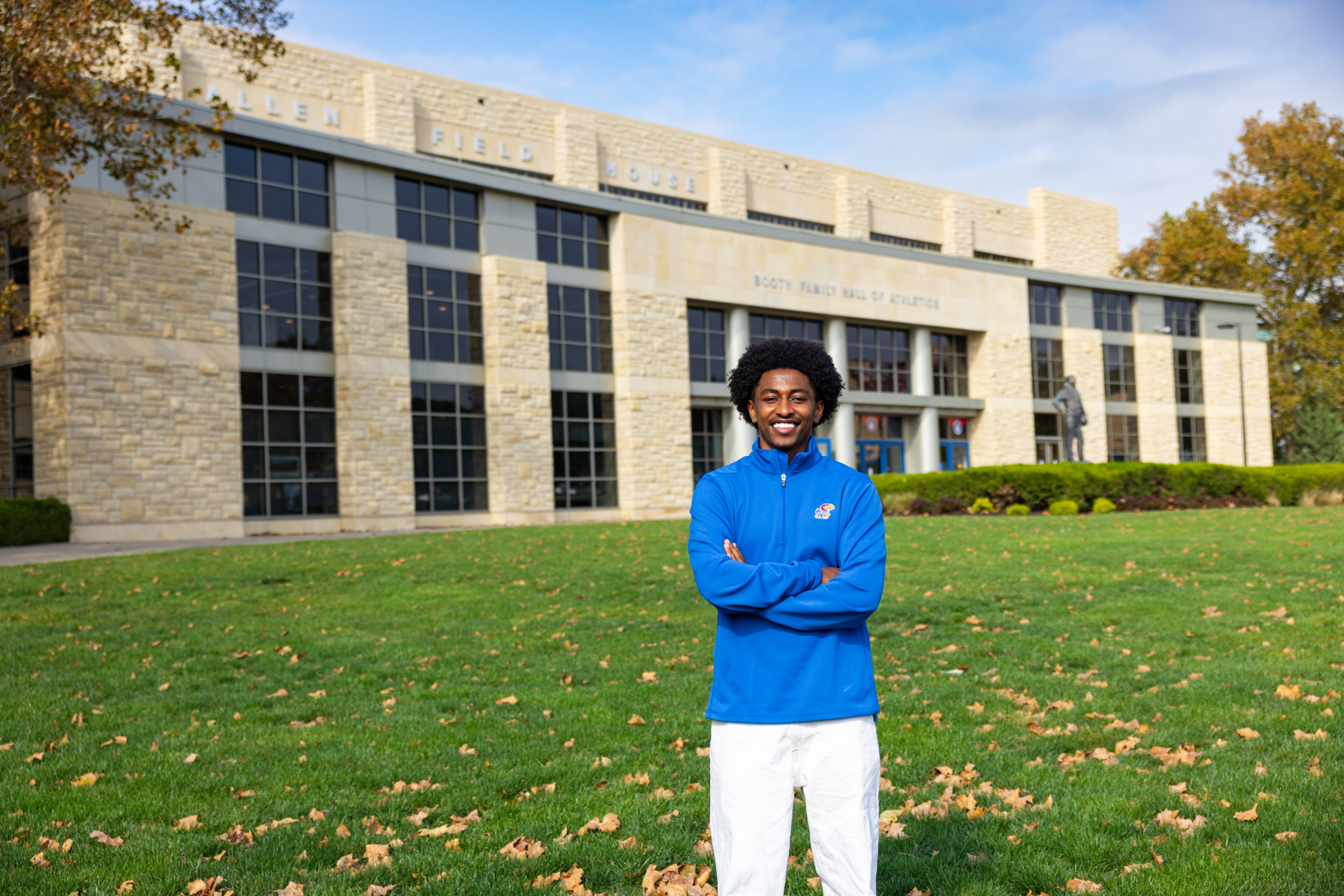
Nathanael Getahun didn't start college planning to pursue two majors. During his sophomore year, he realized he was just as interested in data science as computer science, particularly when thinking about fields such as sports analytics and artificial intelligence.
"A lot of the things I'm excited about, like sports analytics and AI, sit right in the middle of computer science and data science," Getahun said. "With just one major I felt like I'd only be getting half the picture."
For Getahun, the subjects offer complementary skills. Computer science teaches him to build software and write code, while data science helps him interpret information and recognize patterns.
"Computer science gives me the tools to build things, like writing clean code and working on software as part of a team," he said. "Data science teaches me how to actually make sense of information and find the story behind the numbers."
Together, the fields help him approach problems from different angles, from developing a tool to analyzing information and determining what the results mean.
"The biggest benefit for me is getting to see problems from two angles," he said. "In computer science I'm thinking about how to build something, and in data science I'm thinking about what it actually means and whether it's useful."
Danny Anliker pairs German studies with finance

Danny Anliker wanted to pursue both a personal passion and a practical area of study in college. German studies interested him, while finance offered knowledge he could apply to future career opportunities.
The idea took shape during his first year at KU, when a business minor course helped him see a way to study both liberal arts and business.
"I wanted to increase my breadth of study and pursue a passion of mine (German) while incorporating a practical area of study (Finance)," Anliker said.
He sees particular value in combining German language and culture with finance, especially as he considers international communication in the industry.
"The finance industry is very large in Germany and having knowledge of the German language gives a personal touch to my communication and more comfort in international environments," he said.
Studying two disciplines has also brought variety to his semesters, from different classroom environments to different types of assignments.
"A typical semester for my double major has actually left me less burnt out and excited to learn due the multiple disciplines providing for different assignment style and classroom environments," he said.
For Anliker, German studies and finance offer a broader perspective on the people, cultures and industries he may encounter after graduation.
Grace Roethler pairs political science with communication studies

Grace Roethler arrived at KU interested in government, public policy and advocacy. Double majoring in political science and communication studies gave her a way to explore those interests while building skills she hopes to carry into law school.
"Both of my majors complement each other. Political science helps me better understand how government and legal systems work, while communication studies provides insight into how people interact, share ideas and persuade others," she said.
Through leadership roles and campus involvement, Roethler has found opportunities to apply lessons from both fields while developing skills in analysis, public speaking and collaboration.
She also discovered that pursuing two majors doesn't necessarily mean spending more time in college.
"I am set to graduate with two majors in three years, which is something I did not realize was possible before coming to KU," she said.
"Double majoring has allowed me to gain a deeper understanding of people, institutions and communication. Together, those experiences have prepared me for my future career and helped me grow as a student and leader."

Is double majoring right for you?
The four students featured here followed different paths, but each found a way to connect multiple interests through their education. Some combined majors across different schools and colleges, while others paired disciplines within the same academic area.
For prospective students, the decision to double major doesn't have to happen before arriving at KU. Academic advisors can help students explore options, understand program requirements and create a plan that supports their goals.
Whether you're pursuing a career path, exploring a personal passion or discovering new interests along the way, double majoring can be one way to build an education that reflects where you want to go next.
Frequently asked questions about double majoring
Start by exploring the requirements for both majors and talking with academic advisors. Ask about prerequisites, required courses, admission requirements and whether the programs fit your intended graduation timeline. Students should also check the requirements of any professional school they hope to enter.
Not necessarily. Some students complete two majors within one bachelor's degree, while other combinations require separate bachelor's degrees. At KU, the distinction depends on the programs and degree requirements involved. Check with an advisor or the registrar to confirm how your chosen combination is structured.
Studying two fields can require more planning because students must meet the requirements of both programs. Workload depends on the majors, course schedules and requirements that cannot overlap. Academic advisors can help students plan a manageable schedule.
KU students can explore academic pathways that connect different areas of study. The process and degree arrangement depend on the programs involved. Students considering majors in different schools or colleges should check both programs' requirements and work with their advisors to plan coursework.
Many students can complete a double major in four years with careful planning. Graduation timelines depend on major requirements, transfer credit, AP credit and course sequencing. Students should work with advisors to build a realistic academic plan.
That depends on a student's interests and goals. Some students pursue a second major to explore a personal passion, while others combine complementary fields that support a career path. Consider the workload, graduation timeline and long-term goals when deciding whether to pursue two majors.