Inside KU's wood fired kiln tradition
For several days and nights, University of Kansas art students take turns feeding a wood-fired kiln around the clock.
Wood firing is a KU ceramics tradition that gives students the chance to experience an ancient art form firsthand. For many, it’s also one of the most memorable experiences they’ll have at KU.

Most ceramics are fired in electric or gas kilns that can be programmed and monitored with relatively little intervention.
KU’s wood-fired kilns are different. They rely on constant attention from students and artists, who work in shifts to feed the fire, monitor temperatures and respond to the conditions inside the kiln.
KU’s kiln-building class, offered every two years, gives students the opportunity to design and build a wood-fired kiln themselves. The kiln featured in these photos was designed and built by KU students as part of the Fall 2025 kiln-building course.
A tradition shaped by fire
The student-built kiln featured here is one of several wood-fired kilns used by KU ceramics students. KU also maintains a much larger anagama kiln, which is typically fired once a year in early November.
Marshall Maude, associate professor of ceramics, says anagama kilns represent a centuries-old tradition that few students can experience today. "Anagama is a Japanese word, although this type of single-chamber, tunnel-like kiln has been used throughout East Asia including China, Korea and Japan for thousands of years," Maude said.
"Unlike most contemporary kilns, anagama firings are labor-intensive community events that typically require continuous stoking and monitoring for three to 10 days, with teams of people working around the clock."

During the firing, wood ash travels through the kiln and settles naturally on each ceramic piece, creating surfaces that cannot be duplicated. "The combination of flame, ash, heat and atmosphere produces surfaces that are impossible to replicate in electric or gas kilns, making every firing and every piece unique," Maude said.
When art doesn't stop at the classroom
For several days, students work in shifts day and night, constantly feeding the fire to keep the kiln at the right temperature. Every piece inside is shaped not only by the artist who made it, but also by the flames, wood ash and countless hours of teamwork that make the firing possible.
No two firings are ever exactly the same.

Maude said that isn't because wood firing is random.
"It is a complex process with countless variables that interact in ways that make it difficult, if not impossible, to precisely predict or replicate a specific result," he shared. "The goal is not to control every outcome, but to collaborate with the firing process itself."
An experience unlike any other
KU’s kiln-building course is offered every two years, giving students a rare opportunity to design and build a wood-fired kiln themselves. The wood kilns are then fired multiple times each semester, giving students repeated opportunities to experience the process.
For recent KU graduate Grace Staats Gibson, participating in a wood firing became much more than a ceramics assignment. "I helped build the kiln in the fall, so I wanted to see it fired again," she said.
While tending the kiln requires focus and long hours, Gibson found something unexpected in the process. "The experience always brings me a lot of peace. I think the constant state of work and attention can really get my mind off of anything."

That sense of presence is something many wood-fire artists describe. Every few minutes, another log is added to the fire. Temperatures are monitored constantly, and each decision influences the finished work inside.
Post-baccalaureate student Calli Pirner said her first wood firing left her spellbound — and the process still inspires a sense of wonder. "There is definitely an element of magic to a wood firing," she said. "The temperatures inside the kiln become hot enough to transform the wood into fly ash that creates a glassy surface on the ceramic pieces."
Unlike commercial ceramic firing, no two wood-fired pieces are ever exactly alike.

An art of collaboration
Keeping the kiln burning for days isn't something one person can do alone. Students, faculty and alumni rotate through shifts, adding wood, monitoring temperatures and supporting one another throughout the firing.
The experience creates friendships alongside finished artwork. Gibson said the collaborative atmosphere is one of her favorite parts. "Being a part of the team is always fun because there are people you can learn from, but also people you can help and teach."

Pirner echoed that sentiment. "It's a community effort and without the hands of many it's simply not possible," she said. "The final outcome of each pot tells a story, with many days of human labor distilled onto the surface of the work as a permanent brand."
The firing itself becomes as meaningful as the finished ceramics.

Learning through fire
The wood firing process develops patience, problem solving skills and craftsmanship while immersing students in an art form that has existed for thousands of years.
"A multi-day wood firing teaches lessons that extend far beyond technical ceramic skills," Maude said. "Students develop confidence by making real-time decisions, solving unexpected problems and taking responsibility for the success of the firing."
He shared that the experience also builds teamwork and resilience. "Because a wood firing requires continuous attention over several days, students learn to trust themselves and one another while working toward a common goal."

Pirner emphasized that experiences like this are becoming increasingly rare. "Traditional ways of engaging in millennia-old art forms are becoming less common in today's modern world. By being able to engage in old traditions, we can understand more about the past and refresh our perspective on modern ceramics."
For Gibson, wood firing has become central to her artistic identity. "Wood firing plays a significant role in my artistic process. I almost exclusively wood fire my pieces and try to create work that will be enhanced by the process."

More than a kiln
For many students, the greatest impact isn't found in the pottery itself.
It's found in the people.
Maude says the relationships students build often become just as meaningful as the artwork they create.
"They develop meaningful relationships with their peers and with members of the local community who come together to support the firing," he shares. "By the time the firing is complete, they leave with stronger technical abilities, lasting friendships and a greater confidence in themselves as artists and collaborators."
Gibson says KU's ceramics community changed her life. "Community is increasingly harder to find these days, but our firing traditions bring people together through a shared love of ceramics."
She credits the experience with creating lifelong friendships. "I have people in my life now that will be there forever. KU Ceramics changed who I am as a person and allowed me to find a whole new side to myself."
Pirner believes KU offers something few other programs can. "One thing that feels really special about KU's woodfire facilities is there really isn't anything else quite like it in Kansas."
According to Maude, only a handful of universities nationwide still offer traditional kiln building courses and maintain facilities capable of hosting large-scale firings, making KU one of the few places where students can experience both.

An unforgettable KU experience
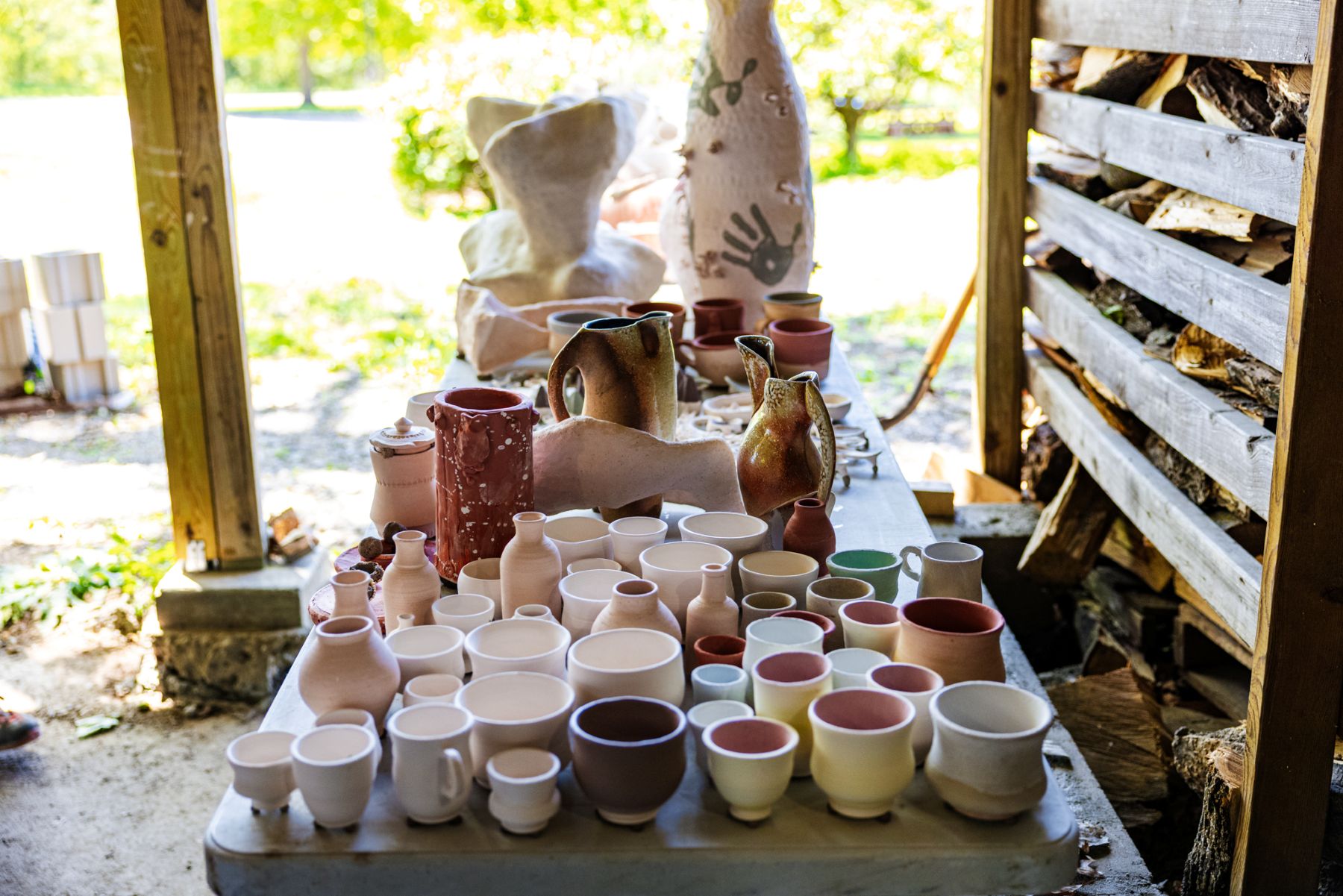
Long after the fire burns out and the kiln cools, students gather to open the chamber and discover the results. Every piece carries subtle variations in color, texture and glaze that could only have been created through days of careful tending and the unpredictable nature of wood firing.
Gibson says the kiln continues to surprise her with every firing. "I am always amazed at how much surface that kiln can create, even when I expect it."
For students interested in ceramics, wood firing is an opportunity to become part of a tradition that blends ancient techniques, artistic experimentation and a close-knit creative community.
Gibson encourages students to embrace the experience and see where it leads. "Give it a shot! At the very least, you’ll make great friends along the way."
Published on
Categories Undergraduate Admissions, Graduate Admissions
Tagged Jayhawk Experiences, Find Your Flock, Experiential Learning